Iterative reconstruction with illumination retrieval
[1]:
import numpy as np
import cupy as cp
import dxchange
import matplotlib.pyplot as plt
from holotomocupy.holo import G, GT
from holotomocupy.magnification import M, MT
from holotomocupy.shift import S, ST, registration_shift
from holotomocupy.recon_methods import CTFPurePhase, multiPaganin
from holotomocupy.proc import linear, dai_yuan
from holotomocupy.chunking import gpu_batch
import holotomocupy.chunking as chunking
from holotomocupy.utils import *


%matplotlib inline

chunking.global_chunk = 20
astropy module not found
olefile module not found
[ ]:
# Init data sizes and parametes of the PXM of ID16A
[2]:
n = 256  # object size in each dimension
ntheta = 180  # number of angles (rotations)

center = n/2  # rotation axis

# ID16a setup
ndist = 4

detector_pixelsize = 3e-6
energy = 17.05  # [keV] xray energy
wavelength = 1.2398419840550367e-09/energy  # [m] wave length

focusToDetectorDistance = 1.208  # [m]
sx0 = -2.493e-3
z1 = np.array([1.5335e-3, 1.7065e-3, 2.3975e-3, 3.8320e-3])[:ndist]-sx0
z2 = focusToDetectorDistance-z1
distances = (z1*z2)/focusToDetectorDistance
magnifications = focusToDetectorDistance/z1
voxelsize = detector_pixelsize/magnifications[0]*2048/n  # object voxel size

norm_magnifications = magnifications/magnifications[0]
# scaled propagation distances due to magnified probes
distances = distances*norm_magnifications**2

z1p = z1[0]  # positions of the probe for reconstruction
z2p = z1-np.tile(z1p, len(z1))
# magnification when propagating from the probe plane to the detector
magnifications2 = (z1p+z2p)/z1p
# propagation distances after switching from the point source wave to plane wave,
distances2 = (z1p*z2p)/(z1p+z2p)
norm_magnifications2 = magnifications2/(z1p/z1[0])  # normalized magnifications
# scaled propagation distances due to magnified probes
distances2 = distances2*norm_magnifications2**2
distances2 = distances2*(z1p/z1)**2

# allow padding if there are shifts of the probe
pad = n//16
# sample size after demagnification
ne = int(np.ceil((n+2*pad)/norm_magnifications[-1]/8))*8  # make multiple of 8
[ ]:
## Read data
[3]:
data00 = np.zeros([ntheta, ndist, n, n], dtype='float32')
ref00 = np.zeros([1, ndist, n, n], dtype='float32')

for k in range(ndist):
    data00[:, k] = read_tiff(f'data/data_3d_ald_{n}_{k}.tiff')[:ntheta]
    ref00[:, k] = read_tiff(f'data/ref_3d_ald_{n}_{k}.tiff')
shifts = np.load('data/shifts.npy')[:ntheta, :ndist]
shifts_drift_init = np.load('data/shifts_drift.npy')[:ntheta, :ndist]
shifts_ref_init = np.load('data/shifts_ref.npy')[:ntheta, :ndist]
shifts_ref0_init = np.load('data/shifts_ref0.npy')[:, :ndist]
[ ]:
# Find shifts of reference images
[4]:
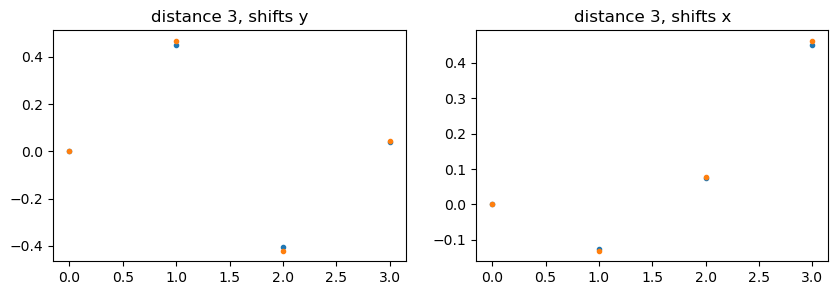
shifts_ref0 = np.zeros([1, ndist, 2], dtype='float32')
for k in range(ndist):
    shifts_ref0[:, k] = registration_shift(ref00[:, k], ref00[:, 0], upsample_factor=1000)

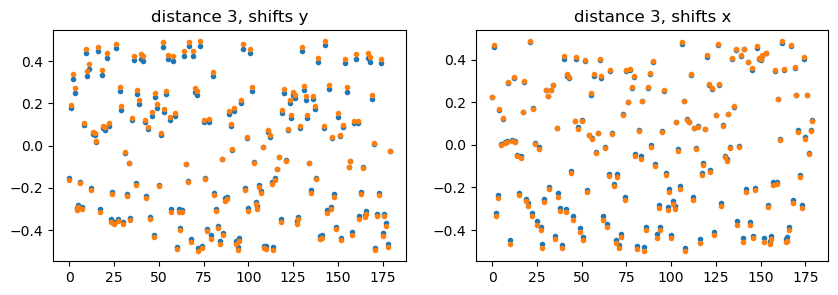
fig, axs = plt.subplots(1, 2, figsize=(10, 3))
im = axs[0].plot(shifts_ref0[0, :, 0], '.')
im = axs[0].plot(shifts_ref0_init[0, :, 0], '.')
axs[0].set_title(f'distance {k}, shifts y')
im = axs[1].plot(shifts_ref0[0, :, 1], '.')
im = axs[1].plot(shifts_ref0_init[0, :, 1], '.')
axs[1].set_title(f'distance {k}, shifts x')
plt.show()


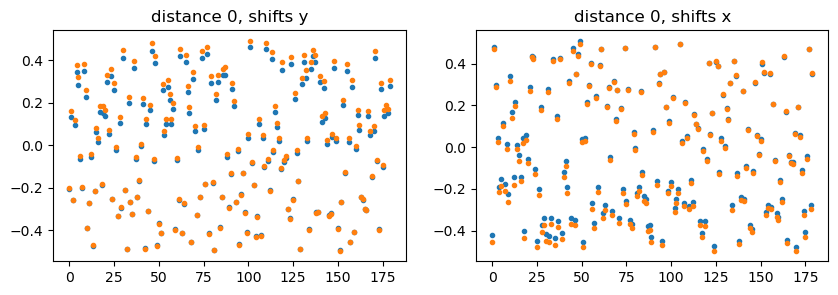
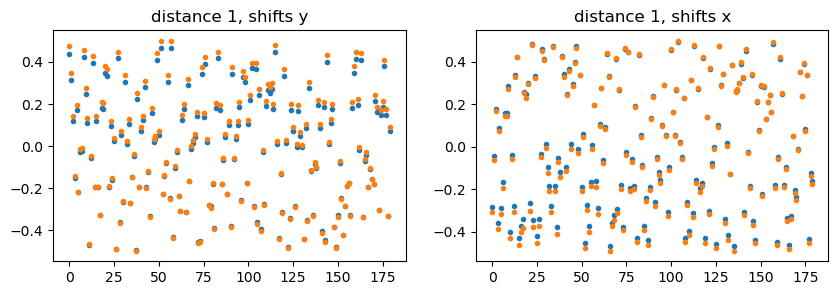
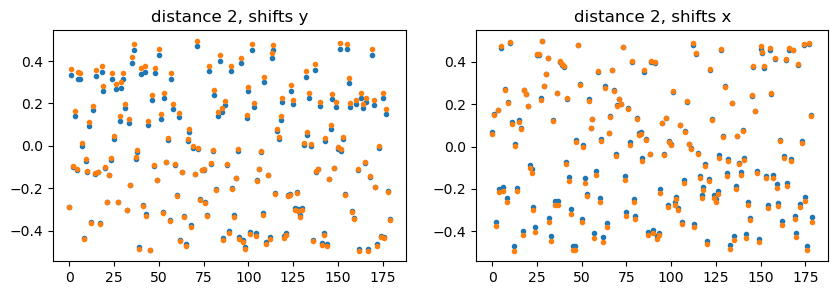
shifts_ref = np.zeros([ntheta, ndist, 2], dtype='float32')
for k in range(ndist):
    im = np.tile(ref00[0, 0], [ntheta, 1, 1])
    shifts_ref[:, k] = registration_shift(data00[:, k], im, upsample_factor=1000)

for k in range(ndist):
    fig, axs = plt.subplots(1, 2, figsize=(10, 3))
    im = axs[0].plot(shifts_ref[:, k, 0], '.')
    im = axs[0].plot(shifts_ref_init[:, k, 0], '.')
    axs[0].set_title(f'distance {k}, shifts y')
    im = axs[1].plot(shifts_ref[:, k, 1], '.')
    im = axs[1].plot(shifts_ref_init[:, k, 1], '.')
    axs[1].set_title(f'distance {k}, shifts x')
    plt.show()
[ ]:
### Assuming the shifts are calculated, shifts refs back
[5]:
data0 = data00.copy()
ref0 = ref00.copy()
# shifted refs for correction
for k in range(ndist):
    # shift refs back
    ref0[:, k] = ST(ref0[:, k].astype('complex64'), shifts_ref0[:, k]).real

ref0c = np.tile(np.array(ref0), (ntheta, 1, 1, 1))
for k in range(ndist):
    # shift refs the position where they were when collecting data
    ref0c[:, k] = S(ref0c[:, k].astype('complex64'), shifts_ref[:, k]).real
[6]:
rdata = data0/ref0c
[7]:
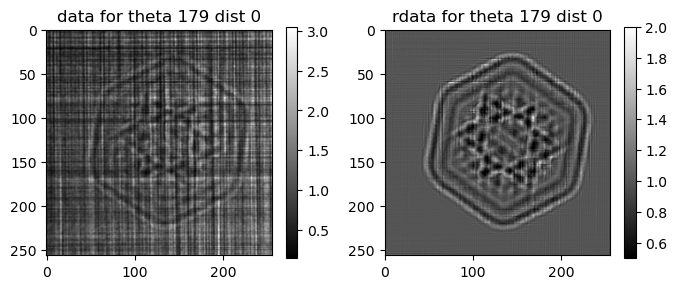
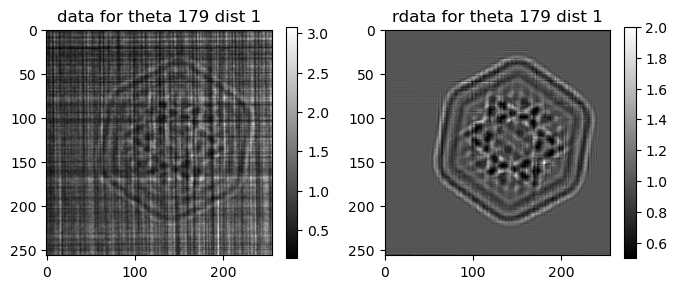
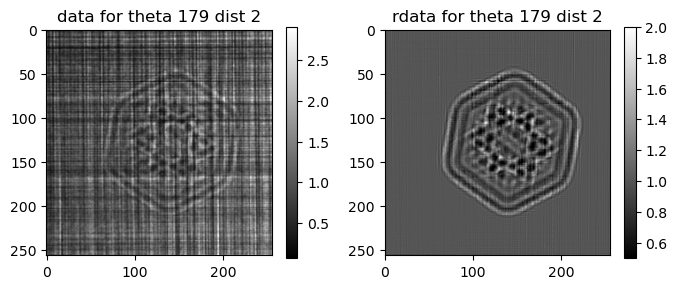
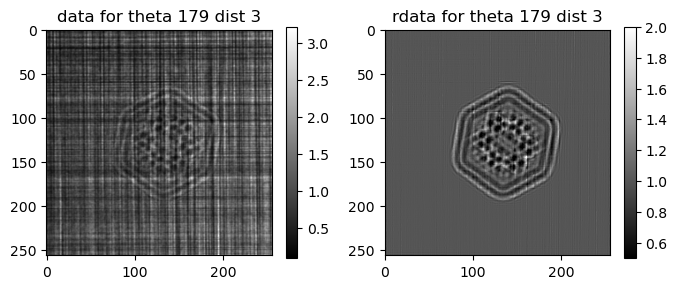
for k in range(4):
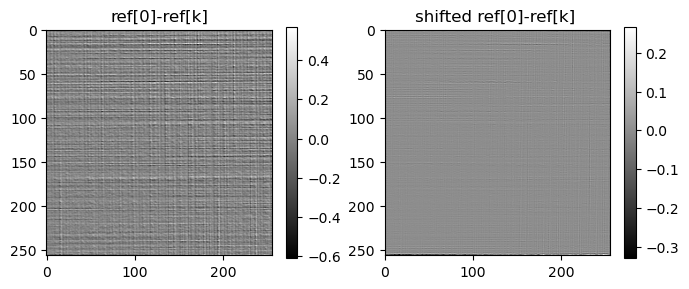
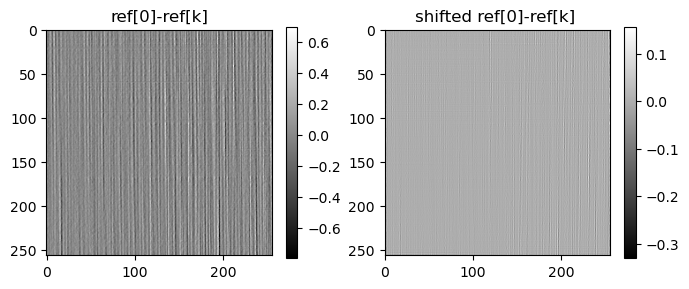
    fig, axs = plt.subplots(1, 2, figsize=(8, 3))
    im = axs[0].imshow(ref00[0, 0]-ref00[0, k], cmap='gray')
    axs[0].set_title('ref[0]-ref[k]')
    fig.colorbar(im)
    # ,vmin=-500,vmax=500)
    im = axs[1].imshow(ref0[0, 0]-ref0[0, k], cmap='gray')
    axs[1].set_title('shifted ref[0]-ref[k] ')
    fig.colorbar(im)

[8]:
for k in range(ndist):
    fig, axs = plt.subplots(1, 2, figsize=(8, 3))
    im=axs[0].imshow(data0[-1,k],cmap='gray')#,vmin = 0.5,vmax=2 )
    axs[0].set_title(f'data for theta {ntheta-1} dist {k}')
    fig.colorbar(im)
    im=axs[1].imshow(rdata[-1,k],cmap='gray',vmin = 0.5,vmax=2)
    axs[1].set_title(f'rdata for theta {ntheta-1} dist {k}')
    fig.colorbar(im)
[ ]:
### Scale images and shift them based on random shifts
[9]:
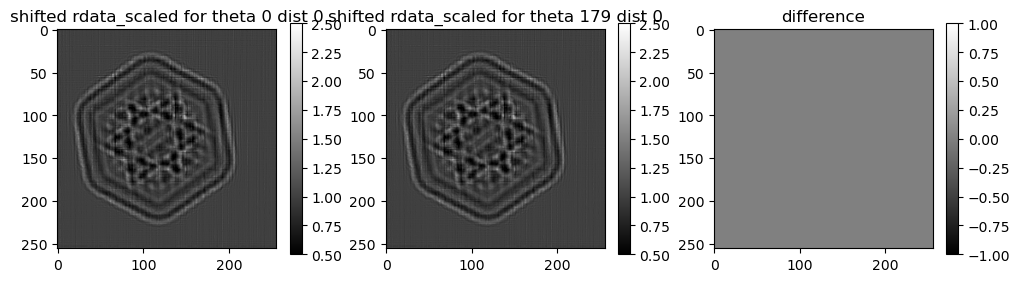
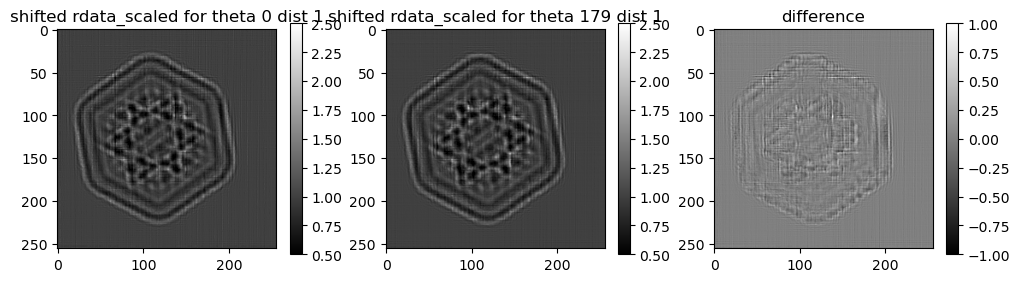
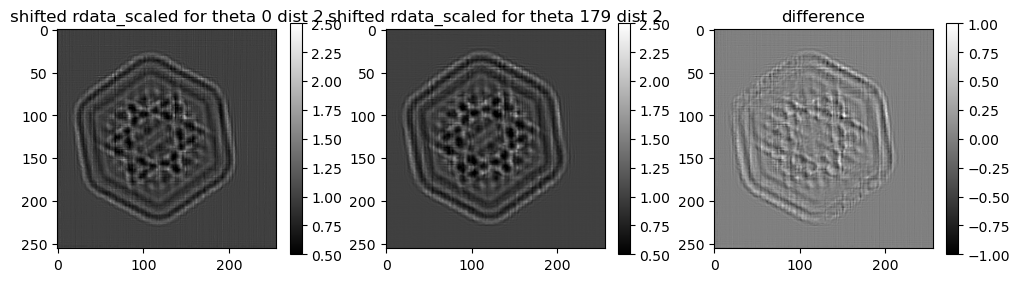
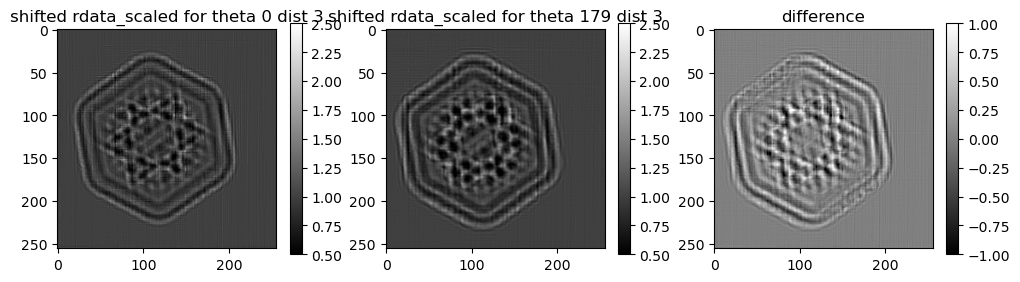
rdata_scaled = rdata.copy()

for k in range(ndist):
    rdata_scaled[:, k] = M(rdata_scaled[:, k], 1 /
                           norm_magnifications[k], n).real
    rdata_scaled[:, k] = ST(rdata_scaled[:, k], shifts[:, k]/norm_magnifications[k]).real

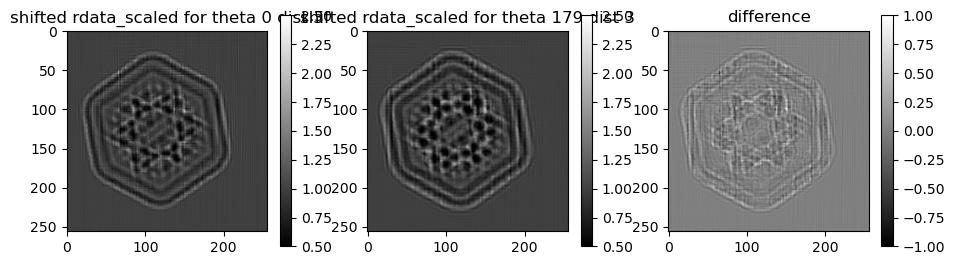
for k in range(ndist):
    fig, axs = plt.subplots(1, 3, figsize=(12, 3))
    im = axs[0].imshow(rdata_scaled[0, 0], cmap='gray', vmin=0.5, vmax=2.5)
    axs[0].set_title(f'shifted rdata_scaled for theta 0 dist {k}')
    fig.colorbar(im)
    im = axs[1].imshow(rdata_scaled[0, k], cmap='gray', vmin=0.5, vmax=2.5)
    axs[1].set_title(f'shifted rdata_scaled for theta {ntheta-1} dist {k}')
    fig.colorbar(im)
    im = axs[2].imshow(rdata_scaled[0, k]-rdata_scaled[0, 0], cmap='gray', vmin=-1, vmax=1)
    axs[2].set_title(f'difference')
    fig.colorbar(im)
[ ]:
### Align images between different planes
[ ]:
#### Approach 2. Align CTF reconstructions from 1 distance
[10]:
recCTF_1dist = np.zeros([ntheta, ndist, n, n], dtype='float32')
distances_ctf = (distances/norm_magnifications**2)[:ndist]

for k in range(ndist):
    recCTF_1dist[:, k] = CTFPurePhase(
        rdata_scaled[:, k:k+1], distances_ctf[k:k+1],wavelength, voxelsize,  1e-1)

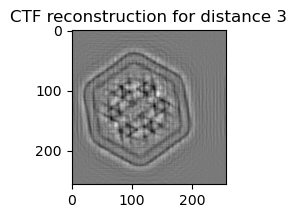
plt.figure(figsize=(2, 2))
plt.title(f'CTF reconstruction for distance {ndist-1}')
plt.imshow(recCTF_1dist[0, -1], cmap='gray')
plt.show()

shifts_drift = np.zeros([ntheta, ndist, 2], dtype='float32')

for k in range(1, ndist):
    shifts_drift[:, k] = registration_shift(
        recCTF_1dist[:, k], recCTF_1dist[:, 0], upsample_factor=1000)

# note shifts_drift should be after magnification.
shifts_drift *= norm_magnifications[np.newaxis, :, np.newaxis]

shifts_drift_median = shifts_drift.copy()
shifts_drift_median[:] = np.median(shifts_drift, axis=0)

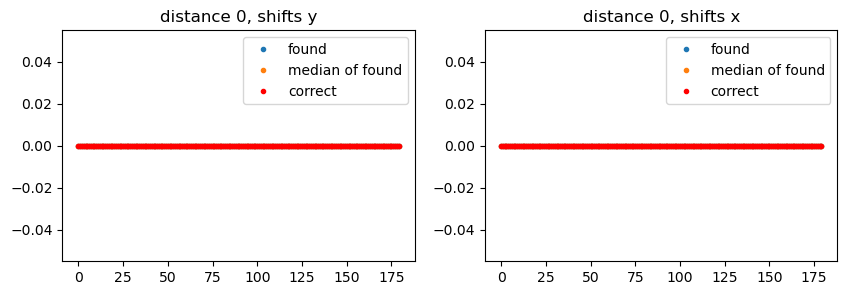
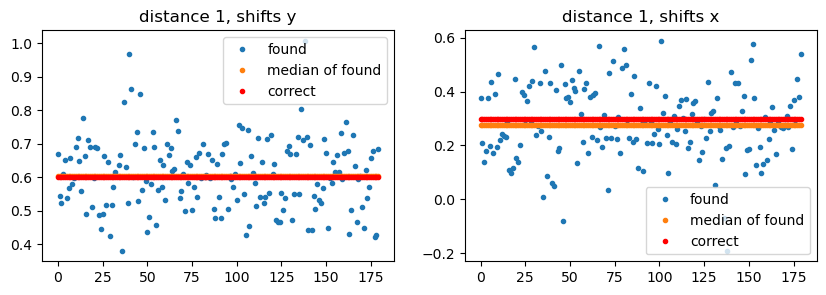
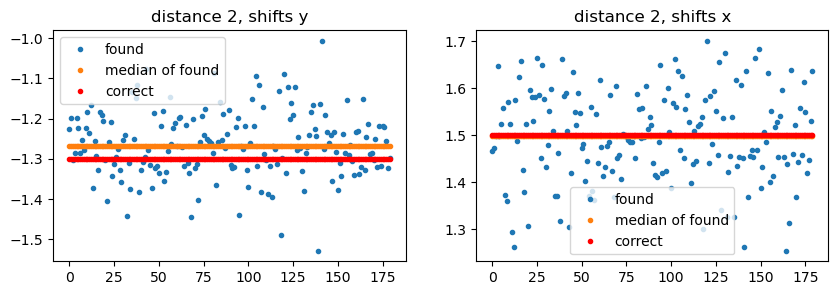
print(shifts_drift_median[0], shifts_drift_init[0])

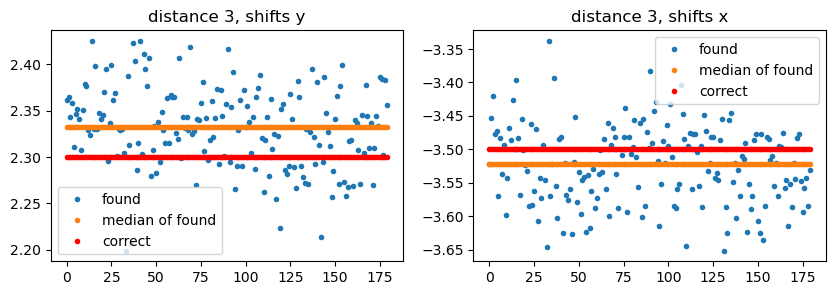
for k in range(ndist):
    fig, axs = plt.subplots(1, 2, figsize=(10, 3))
    im = axs[0].plot(shifts_drift[:, k, 0], '.', label='found')
    im = axs[0].plot(shifts_drift_median[:, k, 0],
                     '.', label='median of found')
    im = axs[0].plot(shifts_drift_init[:, k, 0], 'r.', label='correct')
    axs[0].set_title(f'distance {k}, shifts y')
    axs[0].legend()
    im = axs[1].plot(shifts_drift[:, k, 1], '.', label='found')
    im = axs[1].plot(shifts_drift_median[:, k, 1],
                     '.', label='median of found')
    im = axs[1].plot(shifts_drift_init[:, k, 1], 'r.', label='correct')
    axs[1].set_title(f'distance {k}, shifts x')
    axs[1].legend()
    # plt.show()


# set mediam
shifts_drift = shifts_drift_median
[[ 0.          0.        ]
 [ 0.60404694  0.2751769 ]
 [-1.267518    1.498874  ]
 [ 2.3325052  -3.5213573 ]] [[ 0.   0. ]
 [ 0.6  0.3]
 [-1.3  1.5]
 [ 2.3 -3.5]]
[11]:
rdata_scaled_aligned = rdata_scaled.copy()
for k in range(ndist):
    rdata_scaled_aligned[:, k] = ST(rdata_scaled[:, k], shifts_drift[:, k]/norm_magnifications[k]).real

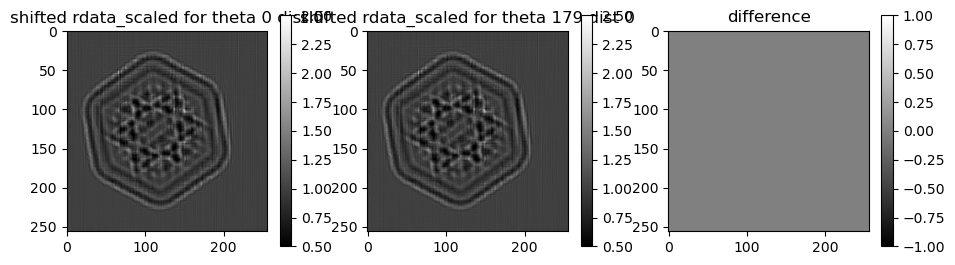
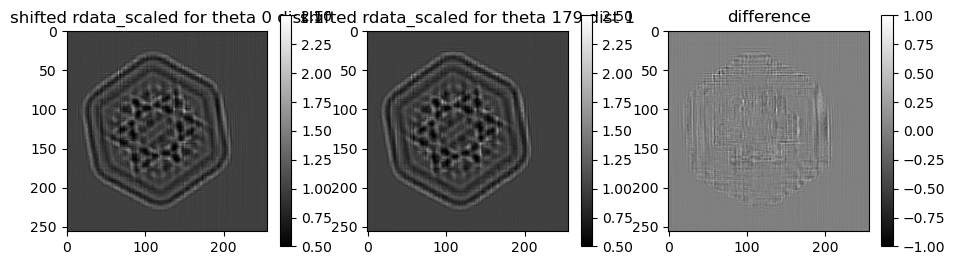
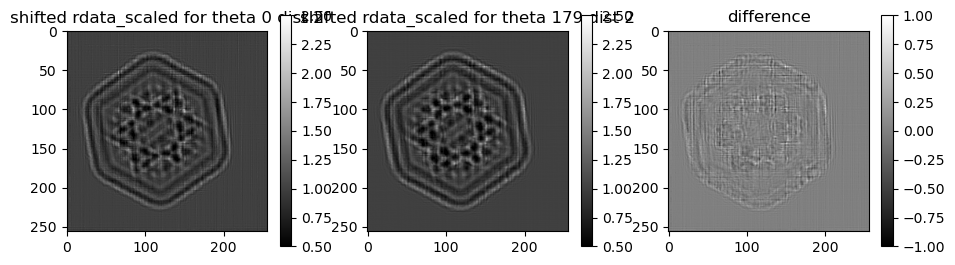
for k in range(ndist):
    fig, axs = plt.subplots(1, 3, figsize=(11, 3))
    im = axs[0].imshow(rdata_scaled_aligned[0, 0], cmap='gray', vmin=0.5, vmax=2.5)
    axs[0].set_title(f'shifted rdata_scaled for theta 0 dist {k}')
    fig.colorbar(im)
    im = axs[1].imshow(rdata_scaled_aligned[0, k], cmap='gray', vmin=0.5, vmax=2.5)
    axs[1].set_title(f'shifted rdata_scaled for theta {ntheta-1} dist {k}')
    fig.colorbar(im)
    im = axs[2].imshow(rdata_scaled_aligned[0, k] - rdata_scaled_aligned[0, 0], cmap='gray', vmin=-1, vmax=1)
    axs[2].set_title(f'difference')
    fig.colorbar(im)
[ ]:
#### combine random and drift sample shifts
[12]:
shifts += shifts_drift
[13]:
# distances should not be normalized
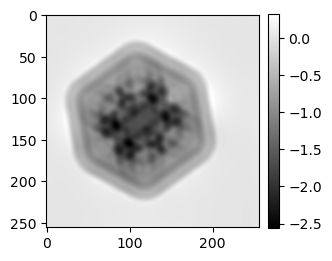
distances_pag = (distances/norm_magnifications**2)[:ndist]
recMultiPaganin = np.exp(1j*multiPaganin(rdata_scaled_aligned, distances_pag, wavelength, voxelsize, 100, 1e-12))
mshow(np.angle(recMultiPaganin[0]))
# dxchange.write_tiff(np.angle(recMultiPaganin), f'data/rec/MultiPaganin.tiff', overwrite=True)
[ ]:
# Construct operators
[ ]:
#### Forward holo: $d=\mathcal{G}_{z_j}\left((\mathcal{G}_{z_j'}\mathcal{S}_{s'_{j}}q)\mathcal{M}_j\mathcal{S}_{s_{j}}\psi\right)$,
#### Adjoint holo: $\psi=\sum_j\mathcal{S}^H_{s_j}\mathcal{M}_j^H\left((\mathcal{G}_{z_j'}\mathcal{S}_{s'_{j}}q)^*\mathcal{G}^H_{z_j}d\right)$,
#### Adjoint holo wrt probe: $q=\sum_{j,k}\mathcal{S}_{s_{k,j}'}\mathcal{G}_{z_j'}^H\left((\mathcal{M}_j\mathcal{S}_{s_{k,j}}\psi_k)^*\mathcal{G}^H_{z_j}d\right)$
[14]:
from holotomocupy.chunking import gpu_batch


@gpu_batch
def _fwd_holo(psi, shifts_ref, shifts, prb):
    prb = cp.array(prb)
    shifts_ref = cp.array(shifts_ref)
    shifts = cp.array(shifts)

    data = cp.zeros([psi.shape[0], ndist, n, n], dtype='complex64')
    for i in range(ndist):
        # ill shift for each acquisition
        prbr = cp.tile(prb, [psi.shape[0], 1, 1])

        prbr = S(prbr, shifts_ref[:, i])
        # propagate illumination
        prbr = G(prbr, wavelength, voxelsize, distances2[i])
        # object shift for each acquisition
        psir = S(psi, shifts[:, i]/norm_magnifications[i])

        # scale object
        if ne != n:
            psir = M(psir, norm_magnifications[i]*ne/(n+2*pad), n+2*pad)

        # multiply the ill and object
        psir *= prbr

        # propagate both
        psir = G(psir, wavelength, voxelsize, distances[i])
        data[:, i] = psir[:, pad:n+pad, pad:n+pad]
    return data


def fwd_holo(psi, prb):
    return _fwd_holo(psi, shifts_ref, shifts, prb)


@gpu_batch
def _adj_holo(data, shifts_ref, shifts, prb):
    prb = cp.array(prb)
    shifts_ref = cp.array(shifts_ref)
    shifts = cp.array(shifts)
    psi = cp.zeros([data.shape[0], ne, ne], dtype='complex64')
    for j in range(ndist):
        psir = cp.pad(data[:, j], ((0, 0), (pad, pad), (pad, pad)))

        # propagate data back
        psir = GT(psir, wavelength, voxelsize, distances[j])

        # ill shift for each acquisition
        prbr = cp.tile(prb, [data.shape[0], 1, 1])
        prbr = S(prbr, shifts_ref[:, j])

        # propagate illumination
        prbr = G(prbr, wavelength, voxelsize, distances2[j])

        # multiply the conj ill and object
        psir *= cp.conj(prbr)

        # scale object
        if ne != n:
            psir = MT(psir, norm_magnifications[j]*ne/(n+2*pad), ne)
        # object shift for each acquisition
        psi += ST(psir, shifts[:, j]/norm_magnifications[j])
    return psi


def adj_holo(data, prb):
    return _adj_holo(data, shifts_ref, shifts, prb)


@gpu_batch
def _adj_holo_prb(data, shifts_ref, shifts, psi):
    shifts_ref = cp.array(shifts_ref)
    shifts = cp.array(shifts)

    prb = cp.zeros([data.shape[0], n+2*pad, n+2*pad], dtype='complex64')
    for j in range(ndist):
        prbr = np.pad(data[:, j], ((0, 0), (pad, pad), (pad, pad)))
        psir = psi.copy()

        # propagate data back
        prbr = GT(prbr, wavelength, voxelsize, distances[j])

        # object shift for each acquisition
        psir = S(psir, shifts[:, j]/norm_magnifications[j])

        # scale object
        psir = M(psir, norm_magnifications[j]*ne/(n+2*pad), n+2*pad)

        # multiply the conj object and ill
        prbr *= cp.conj(psir)

        # propagate illumination
        prbr = GT(prbr, wavelength, voxelsize, distances2[j])

        # ill shift for each acquisition
        prbr = ST(prbr, shifts_ref[:, j])
        prb += prbr
    return prb


def adj_holo_prb(data, psi):
    ''' Adjoint Holography operator '''
    return np.sum(_adj_holo_prb(data, shifts_ref, shifts, psi), axis=0)[np.newaxis]


# adjoint test
data = data0.copy()
ref = ref0.copy()
arr1 = np.pad(np.array(data[:, 0]+1j*data[:, 0]).astype('complex64'),
              ((0, 0), (ne//2-n//2, ne//2-n//2), (ne//2-n//2, ne//2-n//2)), 'symmetric')
prb1 = np.array(ref[0, :1]+1j*ref[0, :1]).astype('complex64')
prb1 = np.pad(prb1, ((0, 0), (pad, pad), (pad, pad)))

arr2 = fwd_holo(arr1, prb1)
arr3 = adj_holo(arr2, prb1)
arr4 = adj_holo_prb(arr2, arr1)

print(f'{np.sum(arr1*np.conj(arr3))}==\n{np.sum(arr2*np.conj(arr2))}')
print(f'{np.sum(prb1*np.conj(arr4))}==\n{np.sum(arr2*np.conj(arr2))}')
(274133600+1109.3828125j)==
(274134944-0.0003216255863662809j)
(274126208-1683.2890625j)==
(274134944-0.0003216255863662809j)
[ ]:
#### Forward holo without sample: $d=\mathcal{G}_{z_j}\mathcal{S}_{s'_{j}}q$,
#### Adjoint holo without sample: $q=\sum_j\mathcal{S}^H_{s'_{j}}\mathcal{G}^H_{z_j}d$
[15]:
@gpu_batch
def _fwd_holo0(prb, shifts_ref0):
    shifts_ref0 = cp.array(shifts_ref0)
    data = cp.zeros([1, ndist, n, n], dtype='complex64')
    for j in range(ndist):
        # ill shift for each acquisition
        prbr = S(prb, shifts_ref0[:, j])
        # propagate illumination
        data[:, j] = G(prbr, wavelength, voxelsize, distances[0])[:, pad:n+pad, pad:n+pad]
    return data


def fwd_holo0(prb):
    return _fwd_holo0(prb, shifts_ref0)


@gpu_batch
def _adj_holo0(data, shifts_ref0):
    shifts_ref0 = cp.array(shifts_ref0)
    prb = cp.zeros([1, n+2*pad, n+2*pad], dtype='complex64')
    for j in range(ndist):
        # ill shift for each acquisition
        prbr = cp.pad(data[:, j], ((0, 0), (pad, pad), (pad, pad)))
        # propagate illumination
        prbr = GT(prbr, wavelength, voxelsize, distances[0])
        # ill shift for each acquisition
        prb += ST(prbr, shifts_ref0[:, j])
    return prb


def adj_holo0(data):
    return _adj_holo0(data, shifts_ref0)


# adjoint test
data = data0[0, :].copy()
ref = ref0.copy()
prb1 = np.array(ref[0, :1]+1j*ref[0, :1]).astype('complex64')
prb1 = np.pad(prb1, ((0, 0), (pad, pad), (pad, pad)))
arr2 = fwd_holo0(prb1)
arr3 = adj_holo0(arr2)

print(f'{np.sum(prb1*np.conj(arr3))}==\n{np.sum(arr2*np.conj(arr2))}')
(599587.0625-4.681907653808594j)==
(599600.5+2.613717515487224e-05j)
[ ]:
#### Approximate the probe by solving the L2-norm minimization problem for reference images
[16]:
def line_search(minf, gamma, fu, fd):
    """ Line search for the step sizes gamma"""
    while (minf(fu)-minf(fu+gamma*fd) < 0 and gamma > 1e-12):
        gamma *= 0.5
    if (gamma <= 1e-12):  # direction not found
        # print('no direction')
        gamma = 0
    return gamma


def cg_holo(ref, init_prb,  pars):
    """Conjugate gradients method for holography"""
    # minimization functional
    def minf(fprb):
        f = np.linalg.norm(np.abs(fprb)-ref)**2
        return f

    ref = np.sqrt(ref)
    prb = init_prb.copy()

    for i in range(pars['niter']):
        fprb0 = fwd_holo0(prb)
        gradprb = adj_holo0(fprb0-ref*np.exp(1j*np.angle(fprb0)))

        if i == 0:
            dprb = -gradprb
        else:
            dprb = dai_yuan(dprb,gradprb,gradprb0)
        gradprb0 = gradprb

        # line search
        fdprb0 = fwd_holo0(dprb)
        gammaprb = line_search(minf, pars['gammaprb'], fprb0, fdprb0)
        prb = prb + gammaprb*dprb

        if i % pars['err_step'] == 0:
            fprb0 = fwd_holo0(prb)
            err = minf(fprb0)
            print(f'{i}) {gammaprb=}, {err=:1.5e}')

        if i % pars['vis_step'] == 0:
            mshow_polar(prb[0])

    return prb


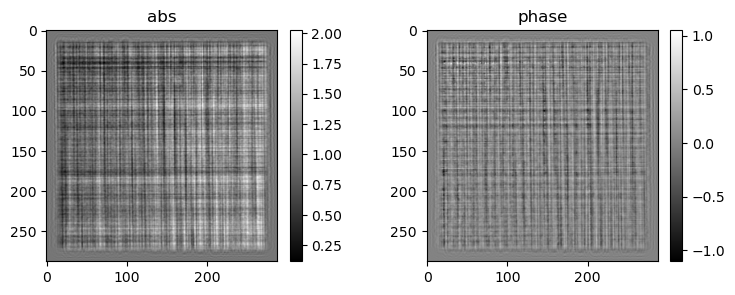
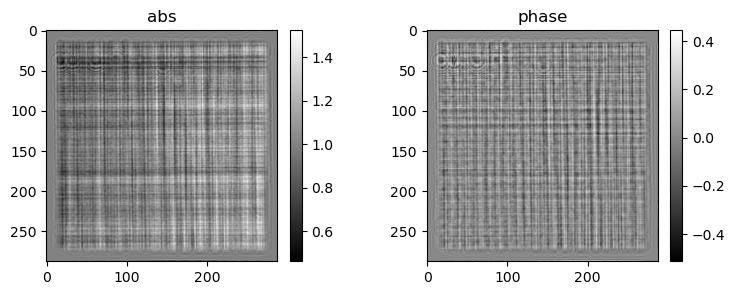
rec_prb0 = np.ones([1, n+2*pad, n+2*pad], dtype='complex64')
ref = ref00.copy()
pars = {'niter': 17, 'err_step': 1, 'vis_step': 16, 'gammaprb': 0.5}
rec_prb0 = cg_holo(ref, rec_prb0, pars)
0) gammaprb=0.5, err=6.65878e+03
1) gammaprb=0.5, err=1.12038e+02
2) gammaprb=0.5, err=4.97403e+01
3) gammaprb=0.25, err=2.40595e+01
4) gammaprb=0.25, err=1.63266e+01
5) gammaprb=0.25, err=1.16797e+01
6) gammaprb=0.25, err=9.59583e+00
7) gammaprb=0.25, err=7.93148e+00
8) gammaprb=0.25, err=7.21276e+00
9) gammaprb=0.25, err=6.54684e+00
10) gammaprb=0.25, err=6.24570e+00
11) gammaprb=0.25, err=5.80487e+00
12) gammaprb=0.25, err=5.65137e+00
13) gammaprb=0.25, err=5.43148e+00
14) gammaprb=0.25, err=5.37837e+00
15) gammaprb=0.25, err=5.20851e+00
16) gammaprb=0.25, err=5.17690e+00
[ ]:
#### Main reconstruction. $\ \sum_k\sum_j||\mathcal{G}_{z_j}((\mathcal{G}_{z'_j}S_{s'_{kj}}q)(M_j S_{s_{kj}}\psi_k))|-\sqrt{d_{kj}}\|^2_2 + \||\mathcal{G}_{z_0}S_{s^r_j}q|-\sqrt{d^r}\|_2^2\to \text{min}_{\psi_k,q}$
[17]:
def line_search(minf, gamma, fu, fu0, fd, fd0):
    """ Line search for the step sizes gamma"""
    while (minf(fu, fu0)-minf(fu+gamma*fd, fu0+gamma*fd0) < 0 and gamma >= 1/64):
        gamma *= 0.5
    if (gamma < 1/64):  # direction not found
        # print('no direction')
        gamma = 0
    return gamma


@gpu_batch
def _gradient(psi, data, shifts_ref, shifts, prb):
    prb = cp.array(prb)
    shifts_ref = cp.array(shifts_ref)
    shifts = cp.array(shifts)
    res = cp.zeros([psi.shape[0], ne, ne], dtype='complex64')
    fpsires = cp.zeros([psi.shape[0], ndist, n, n], dtype='complex64')
    for j in range(ndist):
        # ill shift for each acquisition
        prbr = cp.tile(prb, [psi.shape[0], 1, 1])
        prbr = S(prbr, shifts_ref[:, j])
        # propagate illumination
        prbr = G(prbr, wavelength, voxelsize, distances2[j])
        # object shift for each acquisition
        psir = S(psi, shifts[:, j]/norm_magnifications[j])

        # scale object
        if ne != n:
            psir = M(psir, norm_magnifications[j]*ne/(n+2*pad), n+2*pad)

        # multiply the ill and object
        psir *= prbr

        # propagate both
        psir = G(psir, wavelength, voxelsize, distances[j])
        fpsi = psir[:, pad:n+pad, pad:n+pad]
        fpsires[:, j] = fpsi

        ###########################
        psir = fpsi-data[:, j]*np.exp(1j*(np.angle(fpsi)))

        psir = cp.pad(psir, ((0, 0), (pad, pad), (pad, pad)))

        # propagate data back
        psir = GT(psir, wavelength, voxelsize, distances[j])

        # ill shift for each acquisition
        prbr = cp.tile(prb, [psi.shape[0], 1, 1])
        prbr = S(prbr, shifts_ref[:, j])

        # propagate illumination
        prbr = G(prbr, wavelength, voxelsize, distances2[j])

        # multiply the conj ill and object
        psir *= cp.conj(prbr)

        # scale object
        if ne != n:
            psir = MT(psir, norm_magnifications[j]*ne/(n+2*pad), ne)
        # object shift for each acquisition
        res += ST(psir, shifts[:, j]/norm_magnifications[j])

    # probe normalization
    res /= cp.amax(cp.abs(prb))**2
    return [res, fpsires]


def gradient(psi, data, prb):
    ''' Gradient wrt psi'''
    return _gradient(psi, data, shifts_ref, shifts, prb)


@gpu_batch
def _gradientprb(psi, data, shifts_ref, shifts, prb):
    prb = cp.array(prb)
    shifts_ref = cp.array(shifts_ref)
    shifts = cp.array(shifts)
    res = cp.zeros([psi.shape[0], n+2*pad, n+2*pad], dtype='complex64')
    fpsires = cp.zeros([psi.shape[0], ndist, n, n], dtype='complex64')

    for j in range(ndist):
        # ill shift for each acquisition
        prbr = cp.tile(prb, [psi.shape[0], 1, 1])
        prbr = S(prbr, shifts_ref[:, j])
        # propagate illumination
        prbr = G(prbr, wavelength, voxelsize, distances2[j])
        # object shift for each acquisition
        psir = S(psi, shifts[:, j]/norm_magnifications[j])

        # scale object
        if ne != n:
            psir = M(psir, norm_magnifications[j]*ne/(n+2*pad), n+2*pad)

        # multiply the ill and object
        psir *= prbr

        # propagate both
        psir = G(psir, wavelength, voxelsize, distances[j])
        fpsi = psir[:, pad:n+pad, pad:n+pad]
        fpsires[:, j] = fpsi

    ###########################
        fpsi = fpsi-data[:, j]*np.exp(1j*(np.angle(fpsi)))

        prbr = np.pad(fpsi, ((0, 0), (pad, pad), (pad, pad)))
        psir = psi.copy()

        # propagate data back
        prbr = GT(prbr, wavelength, voxelsize, distances[j])

        # object shift for each acquisition
        psir = S(psir, shifts[:, j]/norm_magnifications[j])

        # scale object
        psir = M(psir, norm_magnifications[j]*ne/(n+2*pad), n+2*pad)

        # multiply the conj object and ill
        prbr *= cp.conj(psir)

        # propagate illumination
        prbr = GT(prbr, wavelength, voxelsize, distances2[j])

        # ill shift for each acquisition
        prbr = ST(prbr, shifts_ref[:, j])
        res += prbr

    return [res, fpsires]


def gradientprb(psi, data, prb):
    ''' Gradient wrt prb'''
    [gradprb, fprb] = _gradientprb(psi, data, shifts_ref, shifts, prb)
    gradprb = np.sum(gradprb, axis=0)[np.newaxis]
    return [gradprb, fprb]


def cg_holo(data, ref, init, init_prb,  pars):
    """Conjugate gradients method for holography"""
    # minimization functional
    @gpu_batch
    def _minf(fpsi,data):
        res = cp.empty(data.shape[0],dtype='float32')
        for k in range(data.shape[0]):
            res[k] = np.linalg.norm(cp.abs(fpsi[k])-data[k])**2
        return res

    def minf(fpsi,fprb):
        res = np.sum(_minf(fpsi,data))
        if isinstance(fprb, np.ndarray) or isinstance(fprb, cp.ndarray):
            res += np.linalg.norm(np.abs(fprb)-ref)**2
        return res

    #work with sqrt data
    data = np.sqrt(data)
    ref = np.sqrt(ref)

    psi = init.copy()
    prb = init_prb.copy()
    conv = np.zeros(1+pars['niter']//pars['err_step'])

    for i in range(pars['niter']):
        if pars['upd_psi']:
            [grad, fpsi] = gradient(psi, data, prb)
            # Dai-Yuan direction
            if i == 0:
                d = -grad
            else:
                d = dai_yuan(d,grad,grad0)

            grad0 = grad
            fd = fwd_holo(d, prb)
            gammapsi = line_search(minf, pars['gammapsi'], fpsi, 0, fd, 0)
            psi = linear(psi,d,1,gammapsi)

        if pars['upd_prb']:
            [gradprb, fprb] = gradientprb(psi, data, prb)
            fprb0 = fwd_holo0(prb)
            gradprb += adj_holo0(fprb0-ref*np.exp(1j*np.angle(fprb0)))
            gradprb *= 1/(ntheta+1)

            # Dai-Yuan direction
            if i == 0:
                dprb = -gradprb
            else:
                dprb = dai_yuan(dprb,gradprb,gradprb0)
            gradprb0 = gradprb

            # line search
            fdprb = fwd_holo(psi, dprb)
            fdprb0 = fwd_holo0(dprb)
            gammaprb = line_search(minf, pars['gammaprb'], fprb, fprb0, fdprb, fdprb0)
            prb = linear(prb,dprb,1,gammaprb)

        if i % pars['err_step'] == 0:
            fprb = fwd_holo(psi, prb)
            fprb0 = fwd_holo0(prb)
            err = minf(fprb, fprb0)
            conv[i//pars['err_step']] = err
            print(f'{i}) {gammapsi=} {gammaprb=}, {err=:1.5e}')

        if i % pars['vis_step'] == 0:
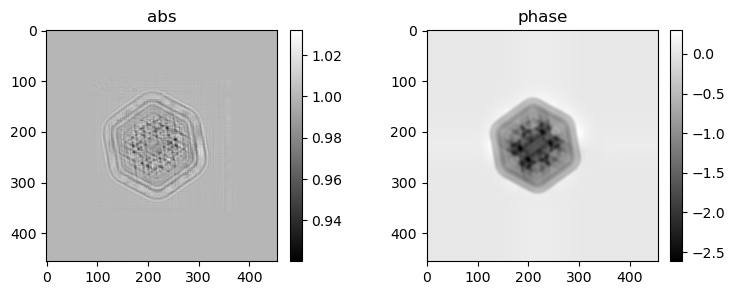
            mshow_polar(psi[0])
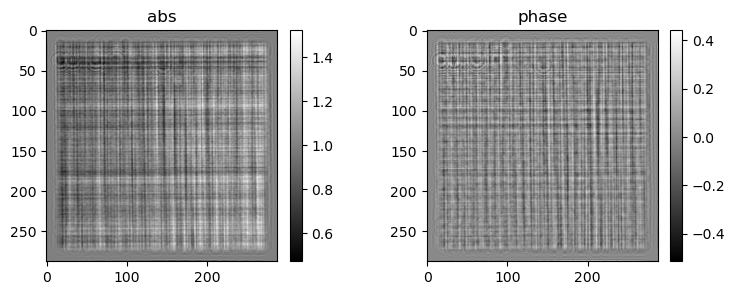
            mshow_polar(prb[0])

    return psi, prb, conv


# if by chunk on gpu
# rec = np.pad(recMultiPaganin, ((0, 0), (ne//2-n//2, ne//2-n//2),
#              (ne//2-n//2, ne//2-n//2)), 'edge')
# rec_prb = rec_prb0.copy()
# ref = ref00.copy()
# data = data00.copy()


#if fully on gpu:
rec = cp.pad(cp.array(recMultiPaganin), ((0, 0), (ne//2-n//2, ne//2-n//2),
             (ne//2-n//2, ne//2-n//2)), 'edge')
rec_prb = cp.array(rec_prb0)
ref = cp.array(ref00)
data = cp.array(data00)

pars = {'niter': 257, 'upd_psi': True, 'upd_prb': True,
        'err_step': 8, 'vis_step': 32, 'gammapsi': 0.5, 'gammaprb': 0.5}
rec, rec_prb, conv = cg_holo(data, ref, rec, rec_prb, pars)
0) gammapsi=0.5 gammaprb=0.5, err=1.29484e+04
[ ]:
plt.imshow(cp.angle(rec[0, 100:200, 100:200]).get(), cmap='gray')
plt.colorbar()
plt.show()
plt.loglog(np.arange(0, pars['niter']//pars['err_step']+1), conv)

write_tiff(np.abs(rec),'data/rec_abs')
write_tiff(np.angle(rec),'data/rec_angle')